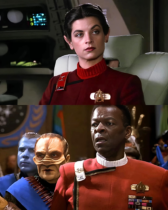
Star Trek VI: The Undiscovered Country

When Star Trek VI: The Undiscovered Country premiered in 1991, it wasn’t just another installment in a long-running franchise—it was a cinematic farewell, a dignified bow for the original Star Trek crew that had been boldly going since 1966. And like all good send-offs, it knew exactly what made the audience care: not just the science fiction, but the human (and alien) drama. Instead of relying on flashy battles or technobabble, Nicholas Meyer, returning to the director’s chair after The Wrath of Khan, delivered a story that was part political thriller, part Cold War allegory, and all heart. It gave these beloved characters a stage worthy of their final curtain call, all while holding a mirror to both history and the franchise itself.

The film opens with a literal bang—Praxis, the Klingon moon, explodes in a mushroom cloud that would make Oppenheimer twitch. It’s the galactic equivalent of Chornobyl, and like that real-world disaster, it forces a political reckoning. Suddenly, the warrior race that has defined itself through strength and opposition is facing ecological collapse. Their empire, like the Soviet Union before it, is crumbling under the weight of unsustainable ambition. And so, the unthinkable happens: the Klingons ask for peace.

What follows is Star Trek at its most Shakespearean—and I don’t just mean that General Chang quotes the Bard like he’s auditioning for a Klingon production of Julius Caesar. The story is soaked in the themes of betrayal, legacy, and the pain of letting go. Captain Kirk, still grieving the death of his son at Klingon hands, is suddenly asked to dine with his enemies. His prejudice is laid bare, and William Shatner—often unfairly dismissed for his acting—gives one of his most restrained, nuanced performances. His disgust is palpable, his conflict genuine. For all of Kirk’s swagger and speeches, he’s still a man shaped by loss. That’s what makes his eventual change of heart so powerful. He’s not just changing policy; he’s evolving as a person.

Then the assassination hits. Chancellor Gorkon, a Gorbachev-like reformer with vision beyond his time, is struck down after a suspicious attack on the Klingon ship. Kirk and McCoy, who genuinely try to save the dying Chancellor in one of DeForest Kelley’s finest scenes, are railroaded into a show trial. The courtroom sequence is a masterclass in tone—equal parts Orwellian nightmare and darkly comic satire of Soviet justice. The fact that Worf’s grandfather is their defense attorney is the kind of world-building wink that makes longtime fans grin.

On Rura Penthe—the alien gulag where hope goes to freeze—we get more than just icy visuals. We see Kirk and Bones at their most desperate, forced to reckon with their mortality in a way that feels earned. And when the Enterprise rescues them, it’s not just a plot beat. It’s a rekindling of faith. Spock’s quiet maneuvering, his trust in his human captain, underscores the heart of Star Trek: that logic and emotion aren’t opposites—they’re partners.

The final act unfolds like a Federation version of The Manchurian Candidate, complete with snipers, conspiracies, and political stakes so high you can feel the tension ripple through the Khitomer conference hall. The reveal of a multi-species conspiracy—Klingons, Starfleet, Romulans—feels like Tinker Tailor Soldier Spy in space. They don’t want peace; they want the war to continue, because peace threatens their power. It’s a sophisticated, adult idea for a franchise born in the optimistic glow of the 1960s.

But the real triumph? It’s in the characters. This crew, these old spacefaring lions, aren’t just relics. They matter. The torch is passed not by death, but by choice. Their final log entry isn’t one of finality, but of transition. And that’s the genius of The Undiscovered Country: it doesn’t just end a chapter. It celebrates what made the story worth telling in the first place.

Oh, and yes—David Warner as Gorkon? Inspired casting. Christopher Plummer as Chang? Gloriously over-the-top in the best possible way. And George Takei as Sulu, finally in command of the Excelsior, gets the “hell yes” moment every fan had been waiting for. It’s the kind of thoughtful, literate science fiction that respects its audience—and its legacy.
The Laws of Physics Are Just Suggestions — Ask Any Chief Engineer

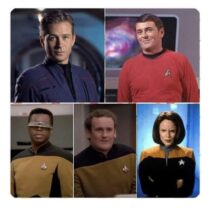
When a warp core’s about to breach, and the EPS conduits are glowing like a Christmas tree on fire, there’s one Starfleet officer who isn’t running to an escape pod or looking for a higher-ranking scapegoat. The Chief Engineer — that grease-stained genius with a tricorder in one hand and an anti-matter injector in the other — is already ten steps into a barely-legal workaround that’ll either save the ship or melt half the deck plating. These are Starfleet’s miracle workers, and frankly, no ship should leave space dock without one.

Let’s get something straight: Chief Engineers aren’t just technicians in coveralls. They are the unsung alchemists of the 23rd and 24th centuries, the fusion of physicist, mechanic, field general, and part-time magician. The position rose to prominence with the Constitution-class refit of 2245, where Starfleet finally admitted what fans had long suspected — the person keeping the warp engines from exploding probably deserves a seat at the senior staff table. These engineers don’t just fix things; they understand them on a molecular level and, more importantly, they improvise with flair when Starfleet specs aren’t enough.

Trip Tucker — bless his Southern drawl and zero tolerance for Vulcan condescension — set the prototype for the modern Chief Engineer: brilliant, temperamental, loyal to a fault, and never afraid to roll up his sleeves. Tucker didn’t just maintain NX-01’s systems; he practically raised them. That warp 5 engine was his baby, and like any good parent, he talked to it, coaxed it, and occasionally yelled at it when it misbehaved. He walked so future engineers could run — and occasionally quantum leap their way out of disaster.

Then there’s Montgomery Scott, the platonic ideal of Starfleet engineering. James Doohan, with his thick brogue and iconic “I’m giving her all she’s got,” gave us the first engineer who understood the drama. Scotty knew that timing was everything — not just in warp recalibration, but in television. Every fix was a suspense beat, a countdown, a near-miss. Behind the scenes, Doohan was inventing technobabble on the fly, helping to shape the very language of Trek science. He wasn’t just an engineer — he was a dramatist with a spanner.

The role matured with Geordi La Forge, a man who brought a quiet, cerebral energy to the job. He wasn’t prone to shouting or overclocking the warp core out of ego. He solved problems with calm, compassionate logic — the kind of engineer who’d take apart a warp manifold while giving advice on romance. Despite early skepticism from veterans like Logan (a name remembered only for his misplaced arrogance), Geordi proved that technical brilliance doesn’t always shout — sometimes, it just sees things more clearly, visor and all.

Miles O’Brien, of course, was the blue-collar workhorse. The guy you trust with your life because he’s probably already saved it six times today. O’Brien brought the rank of Chief Engineer down to Earth — or at least to Deep Space Nine — with a weary, “I really don’t have time for this” authenticity. His arc wasn’t just about fixing things; it was about coping with the cost of constant crisis. No holodeck therapy, no poker night — just another 12-hour shift patching Cardassian junk with Federation optimism.

Then there’s B’Elanna Torres, who stormed onto Voyager with a scowl and a toolkit, daring Starfleet to question her hybrid identity or her methods. She was a brilliant engineer with a Klingon temper and a Starfleet brain, and her tenure was as much about emotional engineering as it was about warp coils. Her journey — from reluctant officer to one of the most trusted voices on Janeway’s bridge — added a rich layer to the archetype: the Chief Engineer as a character in flux, not just a fixer but someone being fixed.

Every Chief Engineer shares one sacred truth: the laws of physics are suggestions, and sometimes, the only way out is through pure ingenuity. These officers rewire their own fear into brilliance. They jury-rig, they invent, they rewrite the rules because they have to. When the shields are down, the captain’s unconscious, and the Romulans are one torpedo away from making your nacelles tomorrow’s salvage, the Chief Engineer isn’t panicking — they’re calculating. They are the plot twist.

So yes, call them miracle workers. But remember: miracles are just engineering problems with deadlines.

Captain Benjamin Sisko

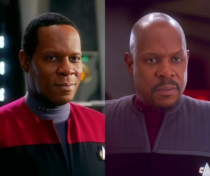
For the first few seasons of Star Trek: Deep Space Nine, Benjamin Sisko wore his hair like a man still tethered to Starfleet convention—a tight, conservative trim, the sort of cut you’d expect on a Federation officer with a desk job and a pension plan. But then, around season four, a shift happened. The man who once looked like he moonlighted as a guidance counselor walked onto the Promenade looking like he could command a fleet and headline a jazz club. The hair was gone. The goatee was in. And with that transformation, Captain Sisko became the emperor of cool in the Star Trek universe.

Let’s not mince words: bald Sisko is definitive Sisko. The look is iconic—majestic even. It brought an intensity to the character that hair simply could not. When Sisko was clean-cut and bare-lipped, he was a competent commander navigating political minefields and Cardassian cold shoulders. But when he embraced the bald dome and that sculpted goatee? He was The Emissary. Not just a Starfleet officer—a mythic figure. You could practically hear the Bajoran Prophets nodding in approval from the Celestial Temple.

Now, for those wondering why Avery Brooks made the change mid-series—it’s actually rooted in the actor’s own identity. Brooks had long preferred the bald-head-and-beard combo. Go back and watch him as Hawk in Spenser: For Hire and its spinoff A Man Called Hawk—he was all bald, all beard, all attitude. That look wasn’t just aesthetic. It was powerful, unapologetic, and deeply tied to his identity as a Black man in Hollywood who wasn’t interested in conforming to safe, sanitized roles. But during the early seasons of DS9, he was required to keep his hair and stay clean-shaven. The studio didn’t want Sisko to look “too intimidating,” a loaded phrase if there ever was one. It’s a quiet testament to the racial politics still simmering under the surface of 1990s television.

By season four, though, that restriction lifted. The writers knew the show was evolving—from a slow-burn political drama to a sprawling war epic with spiritual overtones—and Sisko had to evolve with it. The beard and shaved head weren’t just cosmetic; they mirrored his growing spiritual weight and moral authority. The character was no longer just holding the line at a remote outpost. He was shaping the fate of a quadrant. You don’t go into a war against the Dominion with a baby face and a side part.

Visually, the change was electrifying. Sisko’s new look brought gravity, charisma, and a kind of subdued menace that gave him the presence of a man who could go toe-to-toe with Klingons, changelings, and gods alike. Think about his greatest moments: punching Q, delivering “It’s a fake!” with righteous fury, or making a morally gray bargain with Garak in “In the Pale Moonlight.” All of them came after the transformation. Coincidence? Please.

Sisko’s arc is about transformation—from grieving father to military leader to religious icon. The bald head and beard are part of that metamorphosis. They visually announce that he’s no longer tethered to what Starfleet wants him to be—he’s becoming what the story needs him to be.

So, did Sisko look better with hair or bald? That’s like asking if Gandalf worked better as the Grey or the White. The latter might not have happened without the former, but come on—you know which one you’d follow into battle.

Savvik and Admiral Cartwright

When Kirstie Alley turned down the chance to reprise her role as Lieutenant Saavik in Star Trek VI: The Undiscovered Country, it didn’t just affect casting—it altered the trajectory of the entire film’s plot 🖖✨. The domino effect of her absence led to one of the franchise’s most surprising twists: the betrayal of Admiral Cartwright.

Director Nicholas Meyer, in his autobiography The View From The Bridge: Memories of Star Trek and a Life in Hollywood, spilled the behind-the-scenes truth. He had originally envisioned a trusted and familiar face from previous Star Trek adventures being revealed as a conspirator—someone whose fall from grace would hit hard. Saavik was the natural choice, having appeared in two prior films, but without Alley, that plan crumbled.

Rather than recast Saavik again or dull the emotional impact with a lesser-known character, Meyer made a bold decision: he elevated Admiral Cartwright, played by the deeply charismatic Brock Peters, to traitorous status. Cartwright had shown up in Star Trek IV: The Voyage Home, cautioning Kirk about returning to Earth during the Whale Probe crisis. His role may have been brief, but Peters’ commanding presence left a mark on fans. Choosing him as the turncoat injected a visceral shock into the narrative. After all, Peters’ portrayal exuded Federation loyalty—making his betrayal feel like a gut punch across the galaxy 🚀💥.

Meyer explained his thinking: he wanted the audience to feel blindsided, to realize that even the seemingly noble could harbor darkness. Peters had a history of playing nuanced villains, but to Trek fans, he was solid Starfleet gold. That contrast was what Meyer hung the emotional tension of the film on.

But the casting changes didn’t end there. With Saavik off the table, a new Vulcan needed to step in. Enter Lieutenant Valeris, portrayed by Kim Cattrall 🖖🕶️. She wasn’t just a random replacement—Valeris became Spock’s newest protégé, a role meant to echo Saavik’s relationship with him. Valeris, working in concert with Cartwright, allowed for betrayal both intimately aboard the USS Enterprise and institutionally at the highest levels of Starfleet.

And just to twist the knife even further, a third conspirator was introduced: Colonel West, played by Rene Auberjonois (who would later become fan-favorite Odo in Deep Space Nine). This web of betrayal, originally spun around a returning Saavik, transformed into a broader, more layered conspiracy that enriched the film’s narrative stakes.

So in a galaxy where a single casting decision can ripple across star systems, Kirstie Alley’s absence didn’t just change a role—it reshaped Star Trek history. 🌌🎬

An unapologetic love letter to Star Trek

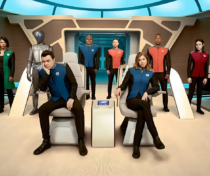
If you’d told me twenty years ago that Family Guy’s Peter Griffin would grow up to command one of the most emotionally resonant, culturally curious starships on television, I would’ve laughed you out of Ten Forward. But here we are. And Jonathan Frakes—Commander Riker himself—sees what many genre aficionados have been shouting from their plasma-lit rooftops for years: The Orville isn’t just a sci-fi comedy with a Seth MacFarlane stamp. It’s a full-throated, warp-drive-powered love letter to Star Trek in its purest, Roddenberry-est form.

Frakes, who’s directed episodes across the Trek multiverse—from TNG and DS9 to Picard—knows a thing or two about what makes this kind of storytelling hum. So when he calls The Orville “very much Roddenberry,” that’s not a casual pat on the back—it’s a nod of deep professional respect. In an era where science fiction often leans into spectacle over substance, MacFarlane zagged, crafting a show that isn’t afraid to press pause on space battles to dissect cultural dilemmas, ethical paradoxes, and good old-fashioned human frailty. Sound familiar?

Of course it does. That was Star Trek’s real prime directive: use the stars as a mirror, not a map. From TOS episodes like “Let That Be Your Last Battlefield” to TNG’s “The Measure of a Man,” Trek has always been less about photon torpedoes and more about moral torpedoes—quietly launching ideas into the social bloodstream under the radar of network suits. The Orville picks up that baton and runs—not with the self-seriousness of later Trek installments, but with a wink and a heart.

Frakes admitted he expected The Orville to be goofier, and who could blame him? This was the guy who built an empire out of fart jokes and anthropomorphic baby rants. But MacFarlane, a lifelong Next Gen fan who allegedly knew the Enterprise-D’s layout better than most of its actors, took his shot at the captain’s chair seriously. He staffed his ship with characters who felt lived-in: Ed Mercer is as much Picard as he is Kirk via a Harvard Lampoon sketch. Kelly Grayson, Claire Finn, Bortus—each member of the crew has that sweet spot between archetype and authenticity that classic Trek did best. And when it works, it works. “About a Girl”? That’s not just a bottle episode; it’s a bottle rocket aimed at the heart of the culture wars.

And let’s not forget: Frakes directed two episodes of The Orville. You can feel his touch in the pacing, in the way scenes breathe and arguments play out with sincerity rather than snark. He’s not alone either. Trek veterans like Robert Duncan McNeill and Brannon Braga (who co-created The Orville) helped MacFarlane make the transition from parody to paragon.

Look, The Orville isn’t perfect. The humor doesn’t always land. The uniforms look like a cross between paramedic scrubs and a soda company’s brand guide. But what it gets right—its emotional intelligence, its willingness to wrestle with complicated issues like identity, parenthood, diplomacy, and forgiveness—that’s where it transcends pastiche and becomes genuine homage.

Meanwhile, the Star Wars vs. Star Trek debate still rages in geek circles, but let’s be honest: Star Wars was always more myth than method. Trek, especially under Roddenberry, asked us to believe that humanity could evolve—not into Jedi, but into better versions of ourselves. MacFarlane tapped into that idea not with nostalgia, but with earnest storytelling and sly subversion. And Frakes, who’s been part of the Federation fabric since the 1980s, saw through the jokes to the substance underneath.

So yes, Jonathan Frakes is right. The Orville is one of the most slept-on shows in MacFarlane’s galaxy-spanning career. It’s also one of the most quietly courageous things to come out of modern genre TV—a reminder that science fiction, at its best, doesn’t just imagine new worlds. It dares to challenge our own.

USS Voyager

The USS Voyager’s mission to the Delta Quadrant was meant to be routine, a mission that would stretch the limits of space exploration and introduce the crew to the mysteries of this new region of space. The starship, an Intrepid-class vessel designed for scientific research, was launched in 2371 with high hopes. Its mission: to boldly go where no Federation ship had gone before, seeking knowledge, peace, and new frontiers. But fate, as it often does, had a different plan.

Barely on its maiden voyage from Deep Space Nine, Voyager, and its crew had no idea they were about to be thrust into a situation none of them could have prepared for. Voyager had no idea they were about to be caught in the grip of a mysterious and powerful force – an energy entity known only as the Caretaker. This incorporeal being, whose intentions were as enigmatic as its form, had a singular goal: to protect the Ocampa, a peaceful race whose survival was in jeopardy. In its attempt to safeguard them, the Caretaker had inadvertently endangered the entire galaxy, tearing a rift in space-time that pulled the Voyager and its crew 70,000 light-years away from home into the unknown expanse of the Delta Quadrant.

The Caretaker, despite its immense power, was dying. It could no longer sustain the Ocampa people on their arid world. The fate of the Caretaker and the Ocampa people had already been sealed, and pulling Voyager across the universe was a last-ditch effort of the Caretaker to ensure the Ocampa survived. The Caretaker gave no care or forethought to the fact that the crew of Voyager had no idea how to survive in this region of space. They were essentially left adrift, badly damaged, and had zero information about their location, the political environment (if any), or why they were there. And worst of all, the crew was utterly cut off from home and could not communicate with The Federation. Any hail would take seventy thousand years to be received. By then, Voyager would not be in the same place, so communication became impossible based on their current technology.

The Federation was now a distant dream, and the safety of the Alpha Quadrant seemed as unreachable as the farthest star. The crew, led by newly promoted Captain Kathryn Janeway in her first command, faced an unimaginable challenge: to survive in a hostile and unknown part of the galaxy and find their way home while continuing their exploration mission. The crew, resilient and determined, had to come to terms quickly that they would never see home in their lifetimes.

However, the vastness of space and the challenges of the Delta Quadrant were not the only obstacles they faced. Along the way, Janeway and her hodgepodge crew encountered a series of threats more dangerous than they could have ever anticipated. Among these was the Borg, the relentless, cybernetic collective whose very presence struck fear into the hearts of every Federation officer. As if stranded in a region of space where the Borg were a constant menace wasn’t enough, Voyager found itself not only in their path but also profoundly entangled with them. The Borg’s terrifying ability to assimilate entire civilizations was a looming danger, but ironically, their technology – a transwarp hub – ultimately provided the key to Voyager’s salvation.

In a twist of fate, the very enemy that posed such a threat to the Voyager’s mission became the instrument of its survival. By seizing control of one of the Borg’s transwarp hubs, Voyager could close the unimaginable distance between the Delta Quadrant and Earth in a single, staggering instant. A journey that should have taken decades was reduced to mere moments, a victory born not out of triumph over the Borg but through their own technology.

Captain Janeway, forever shaped by the harsh lessons of this extended journey, and her crew, who had been tested beyond measure, returned home – not as they had set out, with optimism and certainty, but with a deep understanding of the fragility of life in the universe and the complexity of fate. What started as an accidental detour in space had turned into a profound journey of self-discovery, resilience, and the unshakable belief that, no matter how lost one may seem, the road home might be closer than one thinks.

Captain Montgomery “Scotty” Scott

When you think of Star Trek’s legendary engineer, Montgomery “Scotty” Scott, you might picture him working furiously at a control panel, his face bathed in the dim red glow of the engineering bay, the ship’s fate hanging in the balance. But perhaps one of his most audacious, not to mention creative, acts of repair wasn’t something you’d find in a routine repair log. It was a gamble with time, a wager against fate itself. And it wasn’t in a clean, high-tech starbase; it was in a shuttlecraft, deep in the heart of space, on the verge of a century-long wait.

The year was 2267, and a life-or-death situation aboard the Federation starship Enterprise seized Scotty. During a routine mission, the Enterprise was thrust into an unexpected encounter with the Romulans, causing severe damage to the ship and the crew. The Jenolan, an old Federation starship, was in peril, and its crew was in jeopardy. Scotty knew the ship’s engines could barely hold together, and the distress signal was a faint echo lost among the stars. The crew had to escape.

In a desperate, seemingly impossible attempt to save the ship, Scotty devised a brilliant and ultimately risky solution: he decided to “suspend” himself. Rather than waiting for help the traditional way, with scanners, engines, and predictable systems, Scotty did something few engineers would even dare consider: He stepped into the Jenolan transporter.

But this wasn’t your ordinary matter-energy transport. No, Scotty’s idea was far more unorthodox. Rather than simply transporting himself to safety, he locked his pattern in the transporter’s buffer, not for minutes or hours, but for decades—75 years to be exact. He would exist in a time loop, his pattern cycling endlessly within the machine’s systems. His body would not age, not deteriorate, not experience the ravages of time, yet he would remain conscious, waiting for a rescue that might never come. In essence, Scotty was betting against time itself.

The machines of the 23rd and 24th centuries were as ingenious as they were dangerous. Transporters, designed to be a bridge between places and people, were never meant for such prolonged use. While intended for short-term storage of patterns, transporter systems weren’t designed to hold the consciousness of a living person for nearly a century of continuous use. But Scotty, the brilliant, somewhat eccentric engineer, knew the system well enough to tweak it beyond recognition. He managed to keep his pattern in a state of stasis, existing in the transporter buffer with enough stability to maintain his consciousness without experiencing the slow decay of time. While trapped in the system, his mind was active, thoughts intact, though he was effectively trapped in a time loop, waiting and hoping for rescue.

And that rescue finally came. It took the Enterprise nearly a century to stumble upon the Jenolan, or rather, it took Cmdr La Forge a short time to discover that the transporter systems on the Jenolan still had power. When the Enterprise crew found his presence in the transporter buffer, Scotty had been cycling through the pattern for 75 years. And yet, in that time, he hadn’t lost his sense of self nor his ingenuity. Scotty’s mind had remained sharp despite being physically absent for seven-and-a-half decades. His most incredible creation wasn’t a warp drive or a dilithium coil; it was a time-defying solution, a testament to his remarkable understanding of both the limits and possibilities of technology.

This moment is one of Scotty’s most inventive and daring emergency repairs. It wasn’t just about fixing a broken ship; it was about manipulating time itself, becoming a living testament to what one engineer could do when faced with the ultimate test of survival. The idea of locking oneself in a transporter buffer, knowing that the only way out was a rescue almost a century in the future, is not only brilliant—it’s pure Scotty: resourceful, audacious, and ultimately triumphant in the face of impossible odds.

The story of Miles O’Brien

The story of Miles O’Brien in Star Trek is one of quiet perseverance and understated brilliance. When O’Brian first appears on screen, standing at the transporter console aboard the USS Enterprise-D, he appears to be seen in a role that seems, at first glance, to understate his technical prowess. Many wonder why someone of his skill wasn’t stationed in Main Engineering, working alongside Geordi La Forge. But O’Brien’s journey is a testament to how a career in Starfleet—or any career, for that matter—rarely begins at the top and how unassuming roles can hide profound importance.

Transporter chief isn’t just about “beaming people up.” The position comes with immense responsibility. O’Brien wasn’t merely pressing buttons; he was managing the delicate dance of quantum mechanics that kept crew members alive during transport. A miscalculation could result in tragedy—a fate Star Trek fans know well from transporter mishaps. On the flagship of the Federation, where every officer is expected to excel, being in charge of transporter operations meant ensuring absolute precision. O’Brien’s work had to be flawless, and it often was. Behind the console, he was quietly mastering his craft.

But transporter operations weren’t O’Brien’s only contribution aboard the Enterprise-D. Throughout his time on the ship, he proved repeatedly that his engineering expertise extended far beyond his station. O’Brien’s quick thinking and practical problem-solving approach allows him to play a critical role in saving the day. In critical episodes, such as when the ship faced technical crises, O’Brien’s quick thinking and deep knowledge of starship systems saved lives. Though his title was “transporter chief,” he was more than that. This duality of roles—official and de facto—laid the groundwork for his career’s defining characteristics: adaptability and quiet competence. But there are also other moments where you learn that Chief O’Brien is also a deeply flawed man who struggles with honor and duty, as well as a deep-seated hatred that borders on outright racism for Cardassians.

Once Chief O’Brien transferred to Deep Space Nine and assumed the role of Chief of Operations, his skills as an engineer were finally given the space to shine, and he received the spotlight on his unique problem-solving skills, which he deserved. The station was a hodgepodge of Cardassian and Federation technology, with systems as temperamental as they were essential. It was a chaotic, challenging environment that required someone who could think on their feet and make the impossible happen daily. O’Brien thrived. His ability to bridge his engineering acumen with practical problem-solving made him indispensable to the station’s operations and crew.

Why wasn’t O’Brien in Main Engineering aboard the Enterprise-D? The answer lies in how Starfleet operates. The flagship attracted the best and brightest, but every position, from the bridge to the transporter room, was critical. O’Brien’s skills made him a natural fit to ensure the transporter systems functioned flawlessly, a task no less important than maintaining the warp core. His time at the console also allowed him to build a reputation as a reliable, unflappable engineer—qualities that eventually earned him his promotion to chief of operations on Deep Space Nine.

Or did it? Rumor has it that the Chief was so skilled at using the transporter that he could beam two of Commander Riker’s pips off his collar and onto his own, thus reducing Riker’s rank to Ensign and promoting O’Brian’s from Chief to a full Lieutenant. The Chief kept a collection of pips in one of Keiko’s jewelry boxes on a nightstand by their bed. This shenanigan caused him to be punished and exiled to Deep Space Nine. A punishment that Keiko resented more than Miles. However, it was a punishment Miles wore as a badge of honor, as he could turn this into the shining beacon of his success in his career. As we can see throughout the show, despite Miles’ quiet displeasure with his punishment, he is a Starfleet Officer through and through and a consummate soldier who will do as he ordered despite his feelings on the subject.

O’Brien’s story reminds us that career paths aren’t always linear. Starting in a less glamorous position doesn’t diminish one’s abilities or potential. Instead, it often serves as the foundation for future growth. For O’Brien, the transporter console wasn’t a limitation but a launchpad. His journey from transporter chief to the heart and soul of Deep Space Nine is an inspiring narrative about quiet excellence, hard work, and the importance of being ready when opportunity comes knocking.

Captain Benjamin Sisko

Absolutely. Benjamin Sisko’s actions in Star Trek: Deep Space Nine align strikingly well with the political realism espoused by Machiavelli’s The Prince. He is not merely a Starfleet officer who follows protocol but a leader who understands the weight of responsibility, the murkiness of moral decisions, and the necessity of pragmatic—even ruthless—choices to achieve a greater good. Sisko embodies the qualities of a leader Machiavelli would respect: calculating, adaptable, and willing to prioritize outcomes over ideals when circumstances demand it.

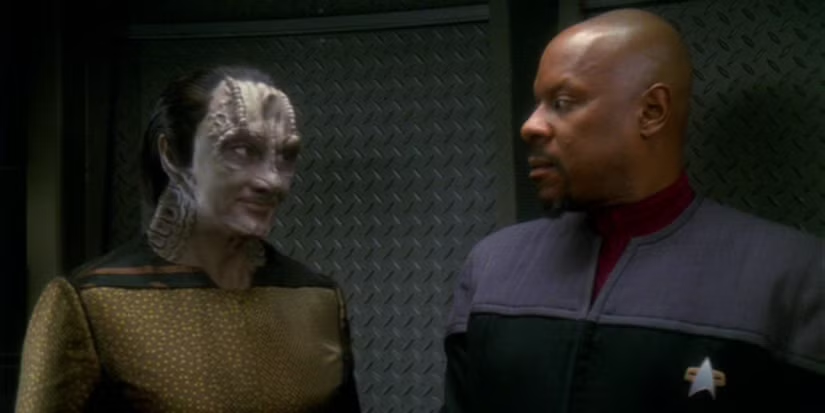
Consider the infamous incident in the episode “In the Pale Moonlight,” where Sisko conspires with Garak, the enigmatic Cardassian tailor, and former intelligence operative, to bring the Romulans into the war against the Dominion. The stakes are impossibly high. If the Dominion prevails, the Alpha and Beta Quadrants as they know it will be obliterated. And if they are successful, they can shape the galaxy. With this existential threat, Sisko manipulates events to fabricate evidence implicating the Dominion in a plot against the Romulans, ultimately leading to their entry into the war. To ensure the plan’s success, Garak assassinates a Romulan senator who discovers the truth, leaving Sisko grappling with the cost of his actions.

Here, Sisko exemplifies Machiavelli’s concept of virtù—a leader’s capacity to shape fortune through decisive action. Machiavelli would argue that Sisko’s actions, while morally abhorrent on the surface, were necessary to secure the survival of billions. For Machiavelli, the end often justifies the means, and Sisko’s willingness to compromise his ethics for the greater good aligns with this principle. His internal conflict, captured in his iconic line, “I can live with it,” underscores the human cost of leadership but does not diminish the cold logic of his choices.

Sisko’s Machiavellian traits extend beyond grand political maneuvers. His governance of Deep Space Nine showcases his ability to balance competing interests with skill and precision. The station is a political powder keg, hosting Bajoran religious factions, Federation officers, and alien merchants while remaining a prime target for Dominion and Maquis interference. Sisko must navigate this volatile environment, ensuring stability without alienating key allies like the Bajorans, whose faith in him as the Emissary of the Prophets adds a layer of complexity. While Sisko is often a diplomat, he is not above using force or intimidation when necessary, as seen in his dealings with Quark or the Klingons.

Moreover, Sisko’s relationships reflect his understanding of power dynamics. He leverages his rapport with individuals like Dax, Kira, and Odo, ensuring their loyalty while granting them the autonomy to act as necessary. He also knows when to draw the line, evidenced by his tough-love approach to his son, Jake, or his unyielding stance when dealing with morally compromised individuals like Michael Eddington. Sisko’s ability to inspire trust and fear equally solidifies his authority.

At his core, Sisko’s Machiavellianism is not rooted in malice or ambition but in a profound sense of duty. He is deeply aware of the stakes in every decision, whether a tactical move in the Dominion War or a personal choice that impacts his crew. He is not a leader who seeks conflict but one who recognizes that survival often demands uncomfortable compromises. This duality—his willingness to embrace the darker aspects of leadership while remaining tethered to his humanity—makes him one of the most complex and compelling figures in Star Trek.

So, does Sisko embody Machiavellian leadership? Without question, he does. His pragmatism, moral flexibility, and ability to navigate the treacherous waters of war and diplomacy make him a quintessential Machiavellian prince. Yet, he also challenges Machiavelli’s philosophy by showing that even the most calculating leaders are not immune to the emotional toll of their decisions. In this way, Benjamin Sisko transcends the archetype, becoming not just a Machiavellian leader but a profoundly human one.

Star Trek: DS9’s Cardassian Tinker Tailor Soldier Spy: Elim Garak explained

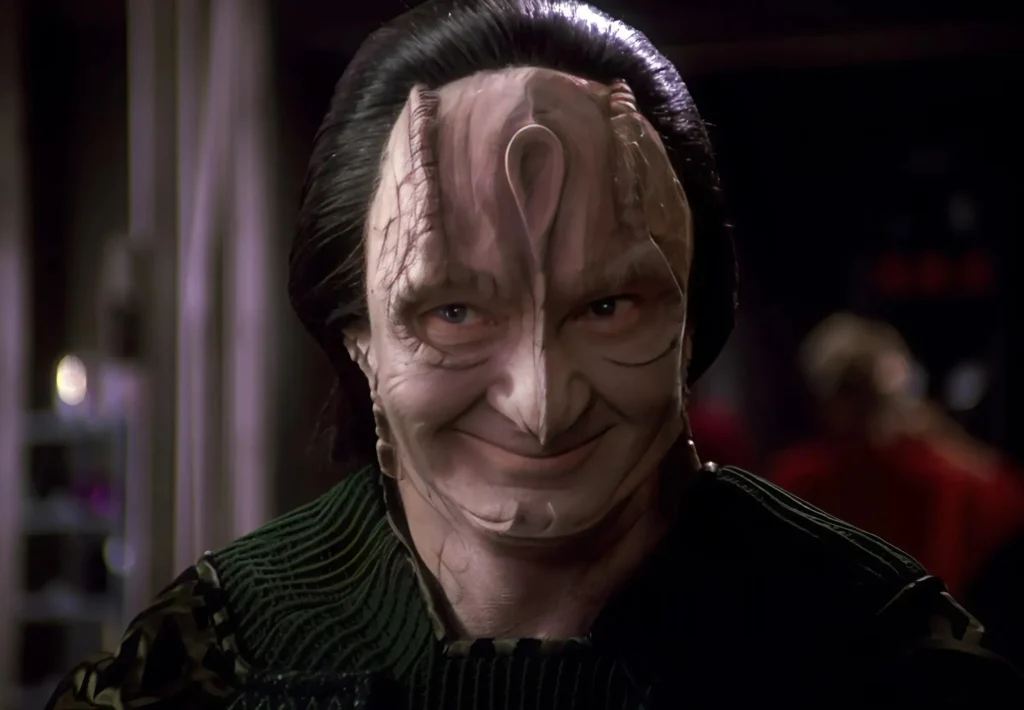
Cardassian Elim Garak (Andrew Robinson) was more than a simple tailor on Star Trek: Deep Space 9. With its premiere in 1993, Star Trek: Deep Space 9 introduced a darker tone to Star Trek, with its morally gray characters and lengthy Dominion War storyline. Introduced in DS9 season 1, episode 3, “Past Prologue,” Garak was one of the show’s most lasciviously gray characters, but he nevertheless became a fan favorite. Despite appearing in only 33 of 176 episodes, Garak remains one of the show’s most memorable and beloved characters.

The Cardassians were introduced as villains on Star Trek: The Next Generation and remained enemies of the Federation for most of Star Trek: Deep Space Nine. DS9 more fully explored the Cardassians, showing that, as with most species, not all are the same. Garak was a tailor aboard Deep Space 9 and befriended several station personnel, including Dr. Julian Bashir (Alexander Siddig) and Constable Odo (René Auberjonois). Garak also had a dark history that became useful during the Dominion War.

Garak Was A Cardassian Spy Before Becoming Star Trek: DS9’s Tailor

“Do you know what the sad part is, Odo? I’m a very good tailor.”

Before the events of Star Trek: Deep Space Nine, Garak was a high-ranking member of the Cardassian intelligence agency known as the Obsidian Order. Garak’s father, Enabran Tain (Paul Dooley), was head of the Order and raised Garak in his image. Tain mistreated Garak as a child and refused to acknowledge the adult Garak as his son. Garak once spent time on Romulus posing as a Gardener at the Cardassian Embassy. Although several prominent Romulans died while Garak was there, the Cardassian never confirmed or denied his involvement.

While working for the Obsidian Order, Garak became an expert interrogator, and his skills for lying and misdirection were well-known. At some point, Garak betrayed Tain, who tried to have him killed. Garak managed to escape but was exiled from Cardassia Prime and took up residence on Terok Nor (later known as Deep Space 9). Once the Cardassians left Terok Nor and Starfleet took over, Garak set up a tailor’s shop on the Promenade. Garak hated exile because he loved Cardassia and desperately wanted to return.

Why Garak Fought With Starfleet In DS9’s Dominion War

“That’s Why You Came To Me, Isn’t It, Captain? Because You Knew I Could Do Those Things That You Weren’t Capable Of Doing.”

Star Trek DS9 In the Pale Moonlight Sisko Garak


Despite being Cardassian, Garak fought alongside Starfleet during the Dominion War. When Starfleet was forced to withdraw from Bajoran space, Garak joined the crew of the USS Defiant, saying that he did not want to live on the space station while it was under the command of Gul Dukat (Marc Alaimo). Throughout his time on Deep Space Nine, Garak formed friendships with many of the station’s crew members; some had even come to trust him. Garak fought alongside his Starfleet friends not because he hated Cardassia but because he believed defeating the Dominion was the best course of action.

Not only did Garak’s knowledge of the Cardassian tactics prove essential during the war, but his background as a spy and assassin established his significance, making him an invaluable resource. In DS9 season 6, episode 19, “In the Pale Moonlight,” Garak infamously helped coerce the Romulans into joining the Dominion War by fabricating evidence and assassinating a Romulan senator. Garak spent the latter part of the Dominion War decoding Cardassian transmissions for Starfleet Intelligence. Although he was troubled that his actions would likely lead to Cardassian deaths, he understood that defeating the Dominion was best for everyone involved.

What Happens To Garak After Star Trek: DS9

“The Truth Is Usually Just An Excuse For Lack Of Imagination.”

When the United Federation of Planets planned an invasion of Cardassia Prime near the end of the Dominion War, Garak helped lead a civilian uprising on Cardassia. After the Dominion wiped out a Cardassian city in retaliation, the Cardassian soldiers began turning against the Dominion, shifting the tide of the battle. Once the Dominion War ended, Garak decided to remain on Cardassia, presumably to aid in the reconstruction efforts. With over 800 million Cardassians dead and much of the infrastructure destroyed, Garak lamented that Cardassia would never be the same. Still, he acknowledged that his people had also caused much harm.

Garak’s last conversation on Star Trek: Deep Space Nine was with Dr. Julian Bashir, who he called “such a good friend,” adding that he was “going to miss [their] lunches together.”

Although Star Trek: Deep Space 9 did not reveal much about what happened to Garak after the conclusion of the series, several Star Trek tie-in novels have told more of Garak’s story. In A Stitch in Time by Andrew Robinson, Garak remained on Cardassia, aiding in the planet’s recovery and helping push for democratic reforms to the government. In other novels, Garak eventually became the Cardassian Ambassador to the Federation. Regardless, Garak would likely remain on Cardassia for the foreseeable future, considering how much he cared for his planet and missed it during his exile.

Garak Returns In Star Trek: Lower Decks — With A Twist

“In Some Dimensions, I’m A Tailor…”

Throughout Star Trek: Lower Decks season 5, Starfleet has been searching for the cause of numerous quantum fissures that have opened wormholes to the multiverse across the galaxy. Lower Decks season 5, episode 9, “Fissure Quest,” reveals that Section 31’s Captain William Boimler (Jack Quaid) has assembled a crew of alternate universe Starfleet officers to investigate these rifts. Among Captain Boimler’s crew is none other than Elim Garak, who serves as the ship’s surgeon on the starship Anaximander. This Garak is a brilliant surgeon, but he does mention that he’s a tailor “in some dimensions.”

While on the Anaximander, Garak met an Emergency Medical Hologram of Dr. Julian Bashir, and the two got married. When Garak goes to rescue his crewmates (who have been captured by “feral Khwopians”), Dr. Bashir protests that Garak is “just a surgeon,” to which the Cardassian replies, “I am a surgeon, but not just.” Garak proves himself a capable fighter in any universe, taking out the Khwopians and rescuing his crew. Garak remains one of Star Trek: Deep Space 9’s most significant characters, and his return in Star Trek: Lower Decks is a pitch-perfect comeback for the lovable, morally gray Cardassian.