
Star Trek VI: The Undiscovered Country

When Star Trek VI: The Undiscovered Country premiered in 1991, it wasn’t just another installment in a long-running franchise—it was a cinematic farewell, a dignified bow for the original Star Trek crew that had been boldly going since 1966. And like all good send-offs, it knew exactly what made the audience care: not just the science fiction, but the human (and alien) drama. Instead of relying on flashy battles or technobabble, Nicholas Meyer, returning to the director’s chair after The Wrath of Khan, delivered a story that was part political thriller, part Cold War allegory, and all heart. It gave these beloved characters a stage worthy of their final curtain call, all while holding a mirror to both history and the franchise itself.

The film opens with a literal bang—Praxis, the Klingon moon, explodes in a mushroom cloud that would make Oppenheimer twitch. It’s the galactic equivalent of Chornobyl, and like that real-world disaster, it forces a political reckoning. Suddenly, the warrior race that has defined itself through strength and opposition is facing ecological collapse. Their empire, like the Soviet Union before it, is crumbling under the weight of unsustainable ambition. And so, the unthinkable happens: the Klingons ask for peace.

What follows is Star Trek at its most Shakespearean—and I don’t just mean that General Chang quotes the Bard like he’s auditioning for a Klingon production of Julius Caesar. The story is soaked in the themes of betrayal, legacy, and the pain of letting go. Captain Kirk, still grieving the death of his son at Klingon hands, is suddenly asked to dine with his enemies. His prejudice is laid bare, and William Shatner—often unfairly dismissed for his acting—gives one of his most restrained, nuanced performances. His disgust is palpable, his conflict genuine. For all of Kirk’s swagger and speeches, he’s still a man shaped by loss. That’s what makes his eventual change of heart so powerful. He’s not just changing policy; he’s evolving as a person.

Then the assassination hits. Chancellor Gorkon, a Gorbachev-like reformer with vision beyond his time, is struck down after a suspicious attack on the Klingon ship. Kirk and McCoy, who genuinely try to save the dying Chancellor in one of DeForest Kelley’s finest scenes, are railroaded into a show trial. The courtroom sequence is a masterclass in tone—equal parts Orwellian nightmare and darkly comic satire of Soviet justice. The fact that Worf’s grandfather is their defense attorney is the kind of world-building wink that makes longtime fans grin.

On Rura Penthe—the alien gulag where hope goes to freeze—we get more than just icy visuals. We see Kirk and Bones at their most desperate, forced to reckon with their mortality in a way that feels earned. And when the Enterprise rescues them, it’s not just a plot beat. It’s a rekindling of faith. Spock’s quiet maneuvering, his trust in his human captain, underscores the heart of Star Trek: that logic and emotion aren’t opposites—they’re partners.

The final act unfolds like a Federation version of The Manchurian Candidate, complete with snipers, conspiracies, and political stakes so high you can feel the tension ripple through the Khitomer conference hall. The reveal of a multi-species conspiracy—Klingons, Starfleet, Romulans—feels like Tinker Tailor Soldier Spy in space. They don’t want peace; they want the war to continue, because peace threatens their power. It’s a sophisticated, adult idea for a franchise born in the optimistic glow of the 1960s.

But the real triumph? It’s in the characters. This crew, these old spacefaring lions, aren’t just relics. They matter. The torch is passed not by death, but by choice. Their final log entry isn’t one of finality, but of transition. And that’s the genius of The Undiscovered Country: it doesn’t just end a chapter. It celebrates what made the story worth telling in the first place.

Oh, and yes—David Warner as Gorkon? Inspired casting. Christopher Plummer as Chang? Gloriously over-the-top in the best possible way. And George Takei as Sulu, finally in command of the Excelsior, gets the “hell yes” moment every fan had been waiting for. It’s the kind of thoughtful, literate science fiction that respects its audience—and its legacy.

The Laws of Physics Are Just Suggestions — Ask Any Chief Engineer

When a warp core’s about to breach, and the EPS conduits are glowing like a Christmas tree on fire, there’s one Starfleet officer who isn’t running to an escape pod or looking for a higher-ranking scapegoat. The Chief Engineer — that grease-stained genius with a tricorder in one hand and an anti-matter injector in the other — is already ten steps into a barely-legal workaround that’ll either save the ship or melt half the deck plating. These are Starfleet’s miracle workers, and frankly, no ship should leave space dock without one.

Let’s get something straight: Chief Engineers aren’t just technicians in coveralls. They are the unsung alchemists of the 23rd and 24th centuries, the fusion of physicist, mechanic, field general, and part-time magician. The position rose to prominence with the Constitution-class refit of 2245, where Starfleet finally admitted what fans had long suspected — the person keeping the warp engines from exploding probably deserves a seat at the senior staff table. These engineers don’t just fix things; they understand them on a molecular level and, more importantly, they improvise with flair when Starfleet specs aren’t enough.

Trip Tucker — bless his Southern drawl and zero tolerance for Vulcan condescension — set the prototype for the modern Chief Engineer: brilliant, temperamental, loyal to a fault, and never afraid to roll up his sleeves. Tucker didn’t just maintain NX-01’s systems; he practically raised them. That warp 5 engine was his baby, and like any good parent, he talked to it, coaxed it, and occasionally yelled at it when it misbehaved. He walked so future engineers could run — and occasionally quantum leap their way out of disaster.

Then there’s Montgomery Scott, the platonic ideal of Starfleet engineering. James Doohan, with his thick brogue and iconic “I’m giving her all she’s got,” gave us the first engineer who understood the drama. Scotty knew that timing was everything — not just in warp recalibration, but in television. Every fix was a suspense beat, a countdown, a near-miss. Behind the scenes, Doohan was inventing technobabble on the fly, helping to shape the very language of Trek science. He wasn’t just an engineer — he was a dramatist with a spanner.

The role matured with Geordi La Forge, a man who brought a quiet, cerebral energy to the job. He wasn’t prone to shouting or overclocking the warp core out of ego. He solved problems with calm, compassionate logic — the kind of engineer who’d take apart a warp manifold while giving advice on romance. Despite early skepticism from veterans like Logan (a name remembered only for his misplaced arrogance), Geordi proved that technical brilliance doesn’t always shout — sometimes, it just sees things more clearly, visor and all.

Miles O’Brien, of course, was the blue-collar workhorse. The guy you trust with your life because he’s probably already saved it six times today. O’Brien brought the rank of Chief Engineer down to Earth — or at least to Deep Space Nine — with a weary, “I really don’t have time for this” authenticity. His arc wasn’t just about fixing things; it was about coping with the cost of constant crisis. No holodeck therapy, no poker night — just another 12-hour shift patching Cardassian junk with Federation optimism.

Then there’s B’Elanna Torres, who stormed onto Voyager with a scowl and a toolkit, daring Starfleet to question her hybrid identity or her methods. She was a brilliant engineer with a Klingon temper and a Starfleet brain, and her tenure was as much about emotional engineering as it was about warp coils. Her journey — from reluctant officer to one of the most trusted voices on Janeway’s bridge — added a rich layer to the archetype: the Chief Engineer as a character in flux, not just a fixer but someone being fixed.

Every Chief Engineer shares one sacred truth: the laws of physics are suggestions, and sometimes, the only way out is through pure ingenuity. These officers rewire their own fear into brilliance. They jury-rig, they invent, they rewrite the rules because they have to. When the shields are down, the captain’s unconscious, and the Romulans are one torpedo away from making your nacelles tomorrow’s salvage, the Chief Engineer isn’t panicking — they’re calculating. They are the plot twist.

So yes, call them miracle workers. But remember: miracles are just engineering problems with deadlines.

Captain Montgomery “Scotty” Scott

When you think of Star Trek’s legendary engineer, Montgomery “Scotty” Scott, you might picture him working furiously at a control panel, his face bathed in the dim red glow of the engineering bay, the ship’s fate hanging in the balance. But perhaps one of his most audacious, not to mention creative, acts of repair wasn’t something you’d find in a routine repair log. It was a gamble with time, a wager against fate itself. And it wasn’t in a clean, high-tech starbase; it was in a shuttlecraft, deep in the heart of space, on the verge of a century-long wait.

The year was 2267, and a life-or-death situation aboard the Federation starship Enterprise seized Scotty. During a routine mission, the Enterprise was thrust into an unexpected encounter with the Romulans, causing severe damage to the ship and the crew. The Jenolan, an old Federation starship, was in peril, and its crew was in jeopardy. Scotty knew the ship’s engines could barely hold together, and the distress signal was a faint echo lost among the stars. The crew had to escape.

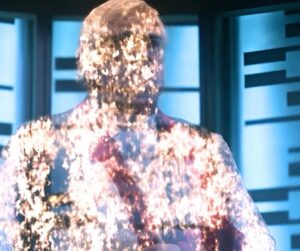
In a desperate, seemingly impossible attempt to save the ship, Scotty devised a brilliant and ultimately risky solution: he decided to “suspend” himself. Rather than waiting for help the traditional way, with scanners, engines, and predictable systems, Scotty did something few engineers would even dare consider: He stepped into the Jenolan transporter.

But this wasn’t your ordinary matter-energy transport. No, Scotty’s idea was far more unorthodox. Rather than simply transporting himself to safety, he locked his pattern in the transporter’s buffer, not for minutes or hours, but for decades—75 years to be exact. He would exist in a time loop, his pattern cycling endlessly within the machine’s systems. His body would not age, not deteriorate, not experience the ravages of time, yet he would remain conscious, waiting for a rescue that might never come. In essence, Scotty was betting against time itself.

The machines of the 23rd and 24th centuries were as ingenious as they were dangerous. Transporters, designed to be a bridge between places and people, were never meant for such prolonged use. While intended for short-term storage of patterns, transporter systems weren’t designed to hold the consciousness of a living person for nearly a century of continuous use. But Scotty, the brilliant, somewhat eccentric engineer, knew the system well enough to tweak it beyond recognition. He managed to keep his pattern in a state of stasis, existing in the transporter buffer with enough stability to maintain his consciousness without experiencing the slow decay of time. While trapped in the system, his mind was active, thoughts intact, though he was effectively trapped in a time loop, waiting and hoping for rescue.

And that rescue finally came. It took the Enterprise nearly a century to stumble upon the Jenolan, or rather, it took Cmdr La Forge a short time to discover that the transporter systems on the Jenolan still had power. When the Enterprise crew found his presence in the transporter buffer, Scotty had been cycling through the pattern for 75 years. And yet, in that time, he hadn’t lost his sense of self nor his ingenuity. Scotty’s mind had remained sharp despite being physically absent for seven-and-a-half decades. His most incredible creation wasn’t a warp drive or a dilithium coil; it was a time-defying solution, a testament to his remarkable understanding of both the limits and possibilities of technology.

This moment is one of Scotty’s most inventive and daring emergency repairs. It wasn’t just about fixing a broken ship; it was about manipulating time itself, becoming a living testament to what one engineer could do when faced with the ultimate test of survival. The idea of locking oneself in a transporter buffer, knowing that the only way out was a rescue almost a century in the future, is not only brilliant—it’s pure Scotty: resourceful, audacious, and ultimately triumphant in the face of impossible odds.