The Harri

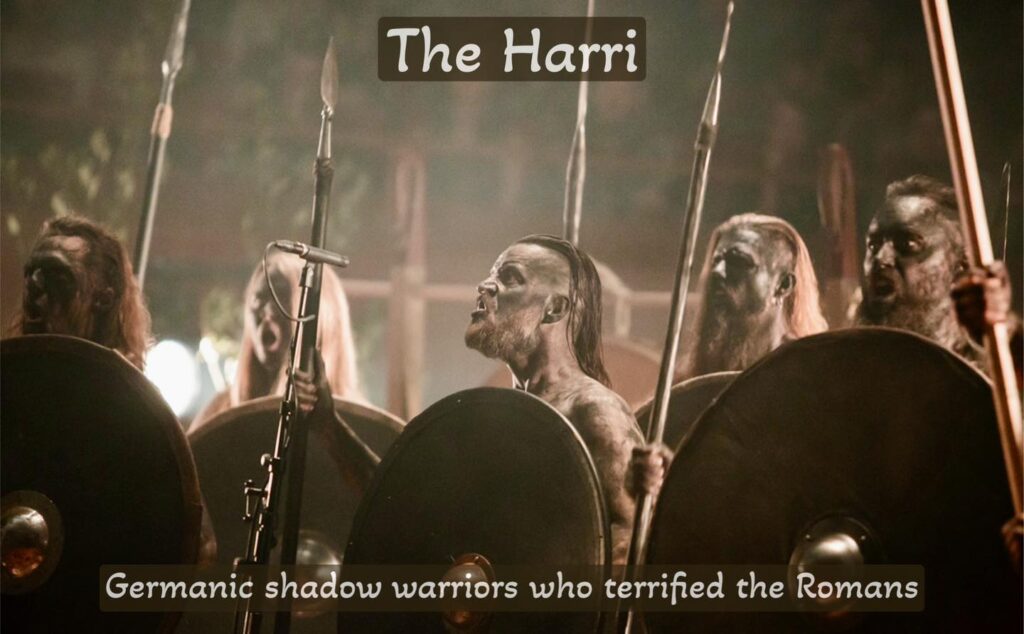
The Harri, known to their enemies as the Germanic Shadow Warriors, emerged from the impenetrable forests of Germany like fierce, elemental spirits of vengeance. The Romans tell us they were not a tribe but an elite cadre of warriors drawn from multiple Germanic tribes that roamed the dense forests of ancient Germania. They were bound together by a shared mastery of guerrilla tactics and psychological warfare, serving as the vanguard of terror in battles against Rome and rival tribes alike.

The Roman historian Tacitus wrote about these warriors with a mixture of awe and dread, describing their tactics as “a tempest of fear and darkness.” He noted their ability to transform the battlefield into a stage of terror: “They appear as shadows, blackened as the night, their presence felt before it is seen.” Cloaked in darkness and smeared with black warpaint, the Harri moved like wraiths through the mist, their war cries breaking the silence with a chilling finality. To a disciplined Roman legion, they were an affront to the order of war—a primal, chaotic force that turned strategy into folly.

“As for the Harii, quite apart from their strength, which exceeds that of the other tribes I have just listed, they pander to their innate savagery by skill and timing: with black shields and painted bodies, they choose dark nights to fight and employing terror and shadow of a ghostly army they cause panic since no enemy can bear a sight so unexpected and hellish; in every battle, the eyes are the first to be conquered.”

Tacitus, Roman historian and politician.

Unlike the Romans, who fought for empire and wealth, the Harri were defenders of something ancient and intangible: their sacred groves, their gods, and the unyielding freedom of their kin. To the Romans, they were barbarians, but their tactics revealed a profound understanding of the human psyche. Pliny the Elder remarked that “their savagery was calculated, their chaos deliberate,” observing how they used fear as a weapon, eroding the discipline of even the most seasoned soldiers. The Harri’s painted faces, gleaming eyes, and howling chants turned the orderly rhythm of Roman warfare into a nightmare. They were warriors forged not in the discipline of the barracks but in the chaos of the wild.

To meet the Harri in battle was not merely to fight an enemy; it was to confront the untamed heart of Germania, a realm where man and forest were one and where survival meant mastering the darkness. I can’t imagine many things more terrifying than confronting a large group of Harri deep in the forests as your Legion is stretched out in a thin line.

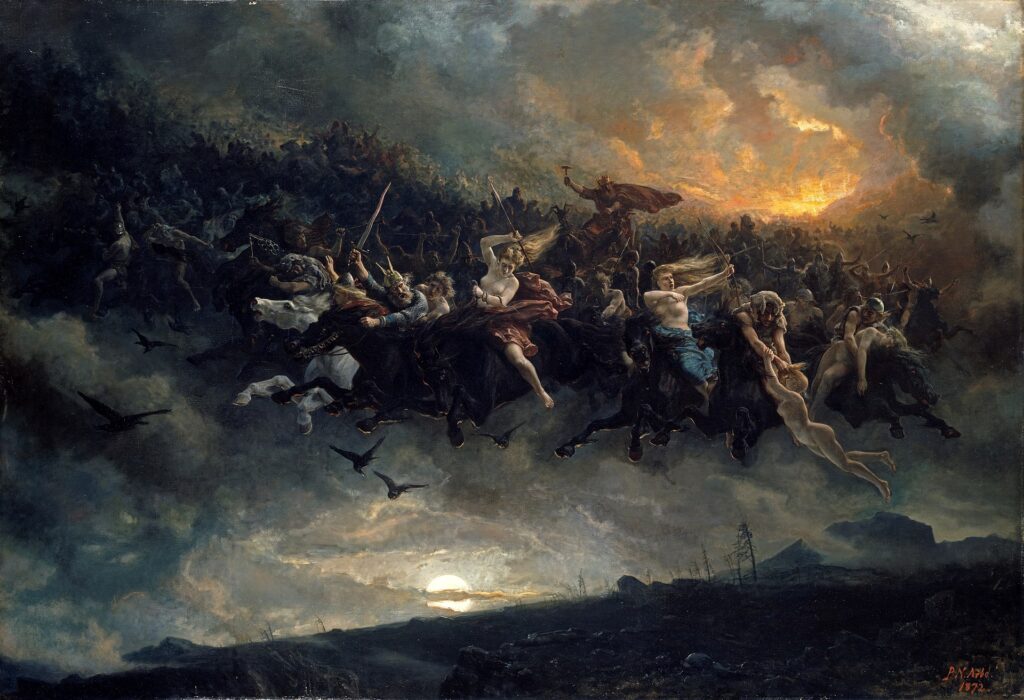
There are varying opinions as to the origin of The Harri; according to John Lindow, Andy Orchard, and Rudolf Simek, connections are commonly drawn between the Harii and the einherjar of Norse mythology, those that have died and gone to Valhalla ruled over by the god Odin, preparing for the events of Ragnarök.

Lindow has written that regarding the theorized connection between the Harii and the Einherjar, “many scholars think there may be basis for the myth in an ancient Odin cult, which would be centered on young warriors who entered into an ecstatic relationship with Odin” and that the name Harii has been etymologically connected to the -herjar element of einherjar.

Simek says that since the connection has become widespread, “one tends to interpret these obviously living armies of the dead as religiously motivated bands of warriors, who led to the formation of the concept of the einherjar as well as the Wild Hunt”.

Modern Day Knights

Knights of Modern-Day Yore
Hiding behind your shields of plastic,
What are you protecting—fear, or power?
Armed against the unarmed,
Marching in formation, ready for war.

Knights of modern-day yore,
Outnumbered, yet unyielding,
Batons gripped tight, poised to strike.
Kevlar and riot shields replace
The chain and plate of legends past.

Your visors mask your eyes,
Hiding the doubts that might remain.
Do you hear the cries for justice?
Or has the clang of orders drowned them out?

Trained for war, yet sent to “protect,”
A populace you no longer see as your own.
Every step you take on city streets
Echoes like thunder in frightened hearts.

The banners of peace are raised before you,
Met with a rain of tear gas and fire.
Each swing of the baton cuts deeper,
Not into flesh, but trust and kinship.

Where is the honor in this battle?
What code do you follow in the fray?
Knights once defended the helpless—
Have you forgotten what it means to serve?

The weight of armor once bore virtue,
A shield for the weak, a sword for the just.
But now your armor is a cage,
Trapping you in fear and mistrust.

Knights of modern-day yore,
The battle is within you, not around.
Lay down the tools of war,
And find the courage to truly protect.

Original Draft
Knights of modern-day yore
Hiding behind your shields of plastic
Armed for war against your own unarmed populace
Knights of modern-day yore
Outnumbered and on the verge of being overwhelmed
Batons in hand, ready to strike
Kevlar and cloth replaced chain and plate
Armed and armored for war against your own populace
Trained for war, guised to protect domestically

This thing

I never thought my life would become so depending on such an object that I could leave it in my pocket till I need it. That is until tonight at work. Half my night I was a wheezy, winded, fat, middle-aged, balding white dude on track to getting his work done early on a Friday morning. That was until after lunch. Really, I was fine all the way up until then, walking around, talking to my associates, freight team associates all the way up until lunch, and all the while I was tapping my left knee when no one was looking, checking for that inhaler. Making sure it was still there, that I somehow hadn’t managed to forget it. Except this is where I went colossally wrong. I transferred it to my jacket pocket because I bumped it a few times and I got scared I might break it in my pocket. Well, my jacket hangs on the cart I’m using for that day, my cart sits in flooring usually. In this store that’s aisle 3. Approximately 75 feet from the front door of the store. Meanwhile, right when I think all is good, and I might be able to get a second bight in a row without having to use my inhaler, is when it struck. And it struck fast. In a matter of 30 seconds, I went from all hunky dory, to a wheezing, coughing fool all the way in the other side of the building. All the way down in the very far back corner. As far from the front door as I can possibly get, without walking through 8 inches of concrete cinder block walls. In that 30 seconds I started to wheeze, I started to pat my pockets down like a goddamn fool and that’s when it struck me. I couldn’t find my inhaler, and I straight up panicked. In my foolish anxiety-driven panic, I blanked on where my inhaler was. Then I remembered and started walking back to the other side of the store. When I hit the middle racetrack, it felt like the entire aisle stretched itself out to miles (when it was probably 500-600 feet to my cart.

Boromir- Plight to Failure, or A Tale of Redemption

Boromir, the son of Denethor II and the Steward of Gondor, faced a profound crisis of identity and purpose. As the last hope for his people, he was deeply troubled by Gondor’s impending doom and his father’s failure to lead. The weight of responsibility to save his homeland and its people crushed him, leading to a sense of desperation and despair.


Why Boromir Failed

Boromir’s failure stemmed from his inability to reconcile his duty to protect the Ring Bearer with his own desires and motivations. He became obsessed with the idea that the One Ring held the key to saving Gondor, and his sense of duty to his people clouded his judgment. This led him to attempt to take the Ring by force, betraying his vow to protect Frodo and ultimately resulting in his own downfall.

Key Factors Contributing to Boromir’s Failure

  1. Vainglory: Boromir’s desire for recognition and admiration from his people, as well as his own sense of self-importance, drove him to prioritize his own ambitions over his duties as a member of the Fellowship.
  2. Desperation: The dire circumstances facing Gondor and his father’s perceived weakness as Steward led Boromir to feel overwhelmed and desperate, causing him to grasp at any solution, including the Ring.
  3. Lack of Faith: Boromir’s reliance on human efforts and his own strength, rather than trusting in the greater plan of the Valar, led him to underestimate the power of the Ring and the true nature of his quest.
  4. Inadequate Guidance: Boromir’s upbringing and education, while noble and well-intentioned, may not have provided him with the wisdom and spiritual guidance necessary to navigate the complexities of his situation.

Redemption

Despite his failure, Boromir’s bravery and repentance in his final moments earned him a measure of redemption. His sacrifice and loyalty to his companions, even in the face of his own flaws and mistakes, serve as a testament to the enduring power of noble character and the possibility of redemption in the face of failure.

“One does not simply walk into Mordor. Its Black Gates are guarded by more than just Orcs. There is evil there that does not sleep, and the Great Eye is ever watchful. It is a barren wasteland, riddled with fire and ash and dust; the very air you breathe is a poisonous fume. Not with ten thousand men could you do this. It is folly.”

Boromir to Elrond’s council. A testament to the wisdom of Boromir’s education.

[Frodo wanders in the woods. Boromir comes up behind him, gathering wood]

Boromir : None of us should wander alone, you least of all. Frodo? I know you suffer, I see it day by day. Are you sure you do not suffer needlessly? There are other ways, Frodo, other paths we might take.

Frodo : I know what you would say, and it would seem like wisdom, but for the warning in my heart.

Boromir : Warning? Against what? We are all afraid, Frodo. But to let that fear drive us to destroy what hope we have… don’t you see? That is madness!

Frodo : There is no other way.

Boromir : I ask only for the strength to defend my people!

[approaches Frodo]

Boromir : If you would but lend me the Ring…

Frodo : [backs away] No!

Boromir : Why do you recoil? I am no thief.

Frodo : You are not yourself.

Boromir : What chance do you think you have? They will find you. They will take the Ring. And you will beg for death before the end!

Trust Thermocline

– by John Bull

One of the things I occasionally get paid to do by companies/execs is to tell them why everything seemed to SUDDENLY go wrong, and subs/readers dropped like a stone.

So, with everything going on at Twitter rn, time for a thread about the Trust Thermocline /1

So: what’s a thermocline?

Well large bodies of water are made of layers of differing temperatures. Like a layer cake. The top bit is where all the the waves happen and has a gradually decreasing temperature. Then SUDDENLY there’s a point where it gets super-cold.

That suddenly is important. There’s reasons for it (Science!) but it’s just a good metaphor. Indeed you may also be interested in the “Thermocline of Truth” which a project management term for how things on a RAG board all suddenly go from amber to red.

But I digress.

The Trust Thermocline is something that, over (many) years of digital, I have seen both digital and regular content publishers hit time and time again. Despite warnings (at least when I’ve worked there). And it has a similar effect. You have lots of users then suddenly… nope.

And this does effect print publications as much as trendy digital media companies. They’ll be flying along making loads of money, with lots of users/readers, rolling out new products that get bought. Or events. Or Sub-brands.

And then SUDDENLY those people just abandon them.

Often it’s not even to “new” competitor products, but stuff they thought were already not a threat. Nor is there lots of obvious dissatisfaction reported from sales and marketing (other than general grumbling). Nor is it a general drift away, it’s just a sudden big slide.

So why does this happen? As I explain to these people and places, it’s because they breached the Trust Thermocline.

I ask them if they’d been increasing prices. Changed service offerings. Modified the product.

The answer is normally: “yes, but not much. And everyone still paid”

Then I ask if they did that the year before. Did they increase prices last year? Change the offering? Modify the product?

Again: “yes, but not much.”

The answer is normally: “yes, but not much. And everyone still paid.”

“And the year before?”

“Yes but not much. And everyone still paid.”

Well, you get the idea.

And here is where the Trust Thermocline kicks in. Because too many people see service use as always following an arc. They think that as long as usage is ticking up, they can do what they like to cost and product.

And (critically) that they can just react when the curve flattens

But with a lot of CONTENT products (inc social media) that’s not actually how it works. Because it doesn’t account for sunk-cost lock-in.

Users and readers will stick to what they know, and use, well beyond the point where they START to lose trust in it. And you won’t see that.

But they’ll only MOVE when they hit the Trust Thermocline. The point where their lack of trust in the product to meet their needs, and the emotional investment they’d made in it, have finally been outweighed by the physical and emotional effort required to abandon it.

At this point, I normally get asked something like:

“So if we undo the last few changes and drop the price, we get them back?”

And then I have to break the news that nope: that’s not how it works.

Because you’re past the Thermocline now. You can’t make them trust you again.

Classic examples of this behaviour are digital subscription services, where the product gets squeezed over time, or print magazines (particularly in B2B) that constantly ramp up their prices a little bit each year until it’s too late.

Virtually the only way to avoid catastrophic drop-off from breaching the Trust Thermocline is NOT TO BREACH IT.

I can count on one hand the times I’ve witnessed a company come back from it. And even they never reached previous heights.

So what’s the lesson for businesses here?

– Watch for grumbling and LISTEN to it.
– Don’t assume that because people have swallowed a price or service change that’ll swallow another one.
– Treat user trust as a finite asset. Because it is.

And I will admit this is one of the reasons I am (with sadness, because I’ve got a lot of value out of this place) watching Elon’s current actions wrt Twitter with curious horror.

Because I’ve NEVER seen someone make such a deep dive for the Trust Thermocline, so quickly.

It’s why I’ve got about 20 big accounts I’m watching on here to see when they personally feel he crosses that Thermocline and begin shifting their main effort and presence elsewhere.

Because that’ll be the moment I suspect things will start changing very quickly. /END

ADDENDUM:

Been reminded of the time I was brought in to talk about this to a gaming company who I can’t name.

The marketing manager got SUPER angry and was like:

“rubbish! we did lootboxing like this five years in a row and people kept paying!”

I’m:

“Mate. That’s my point.”

For those asking, I’m bet-hedging myself while I wait to see what happens. So you’ll find me now on:

Mastodon: mastodon.social/@garius
CounterSocial: counter.social/@garius
CoHost: cohost.org/garius

15 things introverts would never tell you

Introverts get a bad rap in a world that celebrates extroversion and “people-persons”. There are things introverts wish you knew about them that would help any relationship or situation.

15 Things That Introverts Would Never Tell You

COMMUNICATIONRELATIONSHIPS BY MARYANN REID

Introverts get a bad rap in a world that celebrates extroversion and “people-persons”. There are things introverts wish you knew about them that would help any relationship or situation. For instance, we are not anti-social or depressed, we’re just different. In fact, many envy us for our self-contained, cool manner that keeps others calm, focused, and safe. People love us, in secret. As introverts, we have many “ways” that only our closest friends understand. Here are several things about introverts you may not know.

We don’t care about your birthday.

Any introvert who works in an office knows how it feels to be hustled for birthday cake money. It makes us squirm when a random office person cheerily volunteers that it happens to be their birthday. We think they expect us to respond with like enthusiasm and interest, and maybe even accept their invitation to join them for drinks with a group of about 300 other random people to celebrate. Three hundred is a bit of an exaggeration but feels that way to an introvert who just wants to go home. If you don’t invite us, we’re not offended. We’re relieved.

We don’t need you to care about our birthday.

Yeah, we don’t. We have friends who genuinely know us and care if we care. However, an interesting thing about introverts, is some don’t need to celebrate it. We’re okay with quietly honouring the day on our own or with a group of friends we’ve carefully selected. We don’t have to let the world know.

We are not really listening as you recount your weekend.

Unless you are part of our circle of friends, we don’t care what you did last weekend. We are of the mind that everyone has a right to privacy, and if you chose to spend it in a drunken stupor or beating down the door of your ex, then that is up to you. We don’t judge and find it takes too much energy to give it to people we don’t know. Just because we work with you, that doesn’t mean we know you.

We hate crowds.

Large groups of people make us tired. All the stimulation of having so many different types from all walks of life can make us a little woozy. Some introverts are empaths, so they tend to take on the energy of others easily. We sometimes feel like we “know” everyone in the room and get easily overwhelmed with the swirl of activity.

We don’t really like networking events.

This is especially hard for introverts who run a business. Networking makes us feel like we have to perform. We struggle to say the right thing and listen attentively. We don’t really care since we don’t know you. Even in business, we have to feel connected to someone on another level to get the most out of a networking type of event. This takes time, and choosing the right event, and coming up with a plan to offer value to others while getting some for ourselves.

We force ourselves to act like we like you.

This is the nasty truth. We know who we like and don’t. It can stem from many reasons that can have its roots in childhood to what we ate for breakfast this morning. Don’t take it personally. We appreciate honesty, and sometimes it hurts. To survive, we have to supersede these feelings and be nice. Nice can be harder than being real.

We know how to get stuff done.

We pack our alone time with activities–projects, phone calls, emails, rough drafts and blueprints for world takeover of our next big idea (which we have lots of). We value solitude because it lets us experiment with new concepts, plan and stretch our imagination. Anything is possible when we spend time alone, and what we create may change our lives, and yours, too.

We like to write things out.

We love email because it helps us get what we need without interruptions. Interruptions throw us off course, and we need to expend more energy to get back on track. So, please don’t call unless it is a close-ended question.

We feel safe with the right people.

When we have the right people in our lives, we give our all. We give our best selves. We become protective warriors who will fight almost any cause for someone we love. Just ask our friends. We blossom in the right company and shine. It takes us time to find the right people, and when we do, we don’t hold back.

We do have friends, who really like us.

Introverts like people and people like us. Most introverts have no issue with hanging out in groups and spending time with others. If we have friends, it’s because we consciously chose them. We’ve put effort into the relationship, and our friends know that. We go to bars, parties, and meet new people. The difference is that not everyone we meet becomes a friend.

We can do the extrovert thing, for a while.

We have to do that to get along. We can be the life of the party, host the networking event, and be the chairperson of the charity. We do this willingly, knowing that at the end of the day we can go home. When we get there, it may take days, or weeks to replenish ourselves, and feel ready to do that again.

We are not shy, rude or uptight.

At first, we may seem that way. Get to know us, and we can actually make you laugh, and hold a conversation that lasts more than 15 minutes. The thing is, we don’t share this with everyone. Being “social” or “sociable” is an option, not a way of being. We can’t fake happy or excited really well, and we show what we think on our face, not as much in our words.

We are okay alone.

We have lots going on in our heads and don’t need more. Unlike our extrovert counterparts, we don’t need others for stimulation. We’re constantly working out life in our heads. We entertain ourselves with creative projects and know how to take ourselves out for a good time. More people mean more stuff to deal with, and we’ve got enough of our own energy to hold.

We hate small talk.

We’re thinkers, and we relish conversations about big ideas, theories, and ideals. We rarely get into small talk and do so comfortably.

We make a choice to be with you–appreciate it.

We value our alone time and are picky about who we let in. Letting in the wrong person will drain us, leaving nothing for ourselves. We tend to attract extroverts who suck our energy and search out like-minded introverts for our groundedness, deep thinking and sense of control. We appreciate our time with other introverts and have an understanding of each other’s limits and boundaries. Featured photo credit: photo credit: