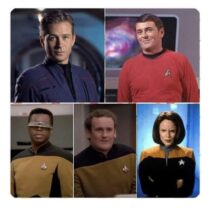
The Laws of Physics Are Just Suggestions — Ask Any Chief Engineer

When a warp core’s about to breach, and the EPS conduits are glowing like a Christmas tree on fire, there’s one Starfleet officer who isn’t running to an escape pod or looking for a higher-ranking scapegoat. The Chief Engineer — that grease-stained genius with a tricorder in one hand and an anti-matter injector in the other — is already ten steps into a barely-legal workaround that’ll either save the ship or melt half the deck plating. These are Starfleet’s miracle workers, and frankly, no ship should leave space dock without one.

Let’s get something straight: Chief Engineers aren’t just technicians in coveralls. They are the unsung alchemists of the 23rd and 24th centuries, the fusion of physicist, mechanic, field general, and part-time magician. The position rose to prominence with the Constitution-class refit of 2245, where Starfleet finally admitted what fans had long suspected — the person keeping the warp engines from exploding probably deserves a seat at the senior staff table. These engineers don’t just fix things; they understand them on a molecular level and, more importantly, they improvise with flair when Starfleet specs aren’t enough.

Trip Tucker — bless his Southern drawl and zero tolerance for Vulcan condescension — set the prototype for the modern Chief Engineer: brilliant, temperamental, loyal to a fault, and never afraid to roll up his sleeves. Tucker didn’t just maintain NX-01’s systems; he practically raised them. That warp 5 engine was his baby, and like any good parent, he talked to it, coaxed it, and occasionally yelled at it when it misbehaved. He walked so future engineers could run — and occasionally quantum leap their way out of disaster.

Then there’s Montgomery Scott, the platonic ideal of Starfleet engineering. James Doohan, with his thick brogue and iconic “I’m giving her all she’s got,” gave us the first engineer who understood the drama. Scotty knew that timing was everything — not just in warp recalibration, but in television. Every fix was a suspense beat, a countdown, a near-miss. Behind the scenes, Doohan was inventing technobabble on the fly, helping to shape the very language of Trek science. He wasn’t just an engineer — he was a dramatist with a spanner.

The role matured with Geordi La Forge, a man who brought a quiet, cerebral energy to the job. He wasn’t prone to shouting or overclocking the warp core out of ego. He solved problems with calm, compassionate logic — the kind of engineer who’d take apart a warp manifold while giving advice on romance. Despite early skepticism from veterans like Logan (a name remembered only for his misplaced arrogance), Geordi proved that technical brilliance doesn’t always shout — sometimes, it just sees things more clearly, visor and all.

Miles O’Brien, of course, was the blue-collar workhorse. The guy you trust with your life because he’s probably already saved it six times today. O’Brien brought the rank of Chief Engineer down to Earth — or at least to Deep Space Nine — with a weary, “I really don’t have time for this” authenticity. His arc wasn’t just about fixing things; it was about coping with the cost of constant crisis. No holodeck therapy, no poker night — just another 12-hour shift patching Cardassian junk with Federation optimism.

Then there’s B’Elanna Torres, who stormed onto Voyager with a scowl and a toolkit, daring Starfleet to question her hybrid identity or her methods. She was a brilliant engineer with a Klingon temper and a Starfleet brain, and her tenure was as much about emotional engineering as it was about warp coils. Her journey — from reluctant officer to one of the most trusted voices on Janeway’s bridge — added a rich layer to the archetype: the Chief Engineer as a character in flux, not just a fixer but someone being fixed.

Every Chief Engineer shares one sacred truth: the laws of physics are suggestions, and sometimes, the only way out is through pure ingenuity. These officers rewire their own fear into brilliance. They jury-rig, they invent, they rewrite the rules because they have to. When the shields are down, the captain’s unconscious, and the Romulans are one torpedo away from making your nacelles tomorrow’s salvage, the Chief Engineer isn’t panicking — they’re calculating. They are the plot twist.

So yes, call them miracle workers. But remember: miracles are just engineering problems with deadlines.
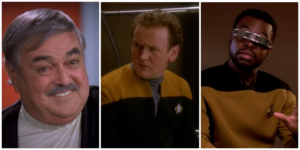
The story of Miles O’Brien

The story of Miles O’Brien in Star Trek is one of quiet perseverance and understated brilliance. When O’Brian first appears on screen, standing at the transporter console aboard the USS Enterprise-D, he appears to be seen in a role that seems, at first glance, to understate his technical prowess. Many wonder why someone of his skill wasn’t stationed in Main Engineering, working alongside Geordi La Forge. But O’Brien’s journey is a testament to how a career in Starfleet—or any career, for that matter—rarely begins at the top and how unassuming roles can hide profound importance.

Transporter chief isn’t just about “beaming people up.” The position comes with immense responsibility. O’Brien wasn’t merely pressing buttons; he was managing the delicate dance of quantum mechanics that kept crew members alive during transport. A miscalculation could result in tragedy—a fate Star Trek fans know well from transporter mishaps. On the flagship of the Federation, where every officer is expected to excel, being in charge of transporter operations meant ensuring absolute precision. O’Brien’s work had to be flawless, and it often was. Behind the console, he was quietly mastering his craft.

But transporter operations weren’t O’Brien’s only contribution aboard the Enterprise-D. Throughout his time on the ship, he proved repeatedly that his engineering expertise extended far beyond his station. O’Brien’s quick thinking and practical problem-solving approach allows him to play a critical role in saving the day. In critical episodes, such as when the ship faced technical crises, O’Brien’s quick thinking and deep knowledge of starship systems saved lives. Though his title was “transporter chief,” he was more than that. This duality of roles—official and de facto—laid the groundwork for his career’s defining characteristics: adaptability and quiet competence. But there are also other moments where you learn that Chief O’Brien is also a deeply flawed man who struggles with honor and duty, as well as a deep-seated hatred that borders on outright racism for Cardassians.

Once Chief O’Brien transferred to Deep Space Nine and assumed the role of Chief of Operations, his skills as an engineer were finally given the space to shine, and he received the spotlight on his unique problem-solving skills, which he deserved. The station was a hodgepodge of Cardassian and Federation technology, with systems as temperamental as they were essential. It was a chaotic, challenging environment that required someone who could think on their feet and make the impossible happen daily. O’Brien thrived. His ability to bridge his engineering acumen with practical problem-solving made him indispensable to the station’s operations and crew.

Why wasn’t O’Brien in Main Engineering aboard the Enterprise-D? The answer lies in how Starfleet operates. The flagship attracted the best and brightest, but every position, from the bridge to the transporter room, was critical. O’Brien’s skills made him a natural fit to ensure the transporter systems functioned flawlessly, a task no less important than maintaining the warp core. His time at the console also allowed him to build a reputation as a reliable, unflappable engineer—qualities that eventually earned him his promotion to chief of operations on Deep Space Nine.

Or did it? Rumor has it that the Chief was so skilled at using the transporter that he could beam two of Commander Riker’s pips off his collar and onto his own, thus reducing Riker’s rank to Ensign and promoting O’Brian’s from Chief to a full Lieutenant. The Chief kept a collection of pips in one of Keiko’s jewelry boxes on a nightstand by their bed. This shenanigan caused him to be punished and exiled to Deep Space Nine. A punishment that Keiko resented more than Miles. However, it was a punishment Miles wore as a badge of honor, as he could turn this into the shining beacon of his success in his career. As we can see throughout the show, despite Miles’ quiet displeasure with his punishment, he is a Starfleet Officer through and through and a consummate soldier who will do as he ordered despite his feelings on the subject.

O’Brien’s story reminds us that career paths aren’t always linear. Starting in a less glamorous position doesn’t diminish one’s abilities or potential. Instead, it often serves as the foundation for future growth. For O’Brien, the transporter console wasn’t a limitation but a launchpad. His journey from transporter chief to the heart and soul of Deep Space Nine is an inspiring narrative about quiet excellence, hard work, and the importance of being ready when opportunity comes knocking.